
Introduction
In a twin extruder, screw design determines how efficiently material is:
- Conveyed
- Melted
- Mixed
- Pressurized
Even with the best machine, poor screw configuration will result in:
- Inconsistent output
- Poor mixing
- High energy consumption
- Material degradation
A well-designed screw system ensures stable and high-quality PVC processing. Before optimizing screw configuration, it is important to understand how issues like twin extruder torque fluctuation and feeding instability directly impact screw performance.
Basic Structure of Twin Extruder Screw
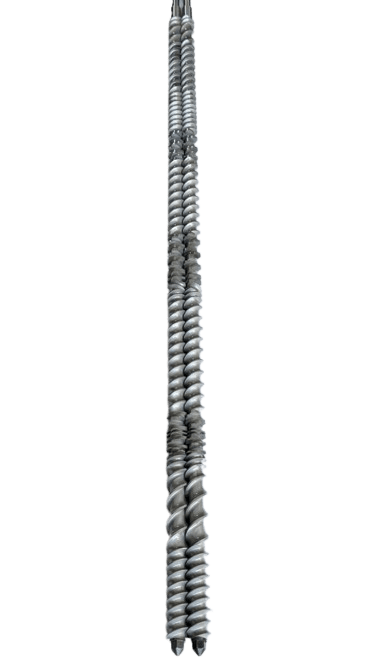
A twin extruder screw is made of modular segments mounted on a shaft. These segments can be changed or rearranged based on application.
Main zones include:
- Feeding Zone
- Melting Zone
- Mixing Zone
- Metering Zone
Each zone plays a specific role in material processing. Improper screw zoning can also lead to dimensional issues such as PVC pipe ovality problems if melt flow is not properly balanced.
Types of Screw Elements
1) Conveying Elements
Purpose:- Transport material forward
- Build pressure gradually
- Helical flight design
- Different pitch angles
2) Kneading Blocks
Purpose:- Intensive mixing
- Breaking material agglomerates
- Disc-shaped segments
- Adjustable angles (30°, 45°, 60°)
3) Reverse Elements
Purpose:- Create back pressure
- Improve mixing efficiency
- Increase residence time
- Enhance dispersion
4) Mixing Elements
Purpose:- Uniform distribution of additives
- Final mixing stage
- Before die section
How Screw Configuration Affects Performance
Mixing Quality
More kneading blocks = better mixing But excessive mixing may cause degradation.Output Capacity
Higher conveying efficiency = higher output. Improper configuration reduces throughput.Torque Load
High shear elements increase torque demand. Balance is critical to avoid overload.Temperature Profile
Screw design affects heat generation inside the barrel. Poor design leads to overheating or uneven melting.Example Screw Configuration for PVC
Typical structure:
- Feed zone → Conveying elements
- Compression zone → Kneading blocks
- Mixing zone → Combination of kneading + reverse elements
- Metering zone → Conveying elements
This ensures:
✔ Proper melting
✔ Uniform mixing
✔ Stable pressure
Common Screw Design Mistakes
- Too many kneading blocks → Overheating
- Poor element sequence → Uneven mixing
- Incorrect pitch → Low output
- No reverse element → Poor dispersion
Many of these issues are also linked to incorrect temperature settings. Refer to our barrel temperature optimization guide for better control.
Optimization Tips for Twin Extruder Screw Design
✔ Customize screw based on PVC formulation
✔ Adjust kneading angle based on mixing requirement
✔ Maintain proper L/D ratio
✔ Monitor torque and melt pressure
✔ Use wear-resistant materials for longer life
For achieving maximum output with the right screw design, also read our guide on increasing extruder output without increasing RPM.
Conclusion
Screw design is the core of twin extruder performance.
The right configuration improves:
 Mixing efficiency Output stability Product quality Energy efficiency
For PVC processing, a well-balanced screw design is essential for long-term success.
If you are facing multiple performance issues, check our complete extruder troubleshooting guide for step-by-step solutions.
Need Help Designing Your Twin Extruder Screw?
We provide:
- Custom screw configuration design
- Process optimization
- Screw & barrel manufacturing
- Complete extrusion consulting