
Introduction
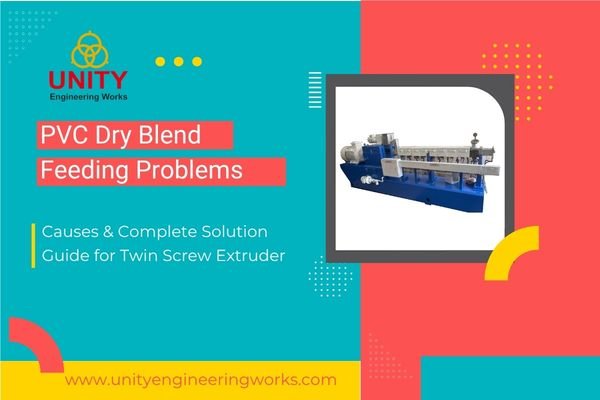
In a twin extruder, feeding consistency is the foundation of stable production.
If material feeding is unstable, it directly causes:
- Torque fluctuation
- Output variation
- Poor mixing
- Surface defects
- Dimensional
- inconsistency
Even a perfectly configured twin extruder cannot perform properly with poor feeding.
Common PVC Dry Blend Feeding Problems
1) Hopper Bridging
One of the most frequent issues.
Material forms an arch inside the hopper and stops flowing.
Causes:
- Poor material flowability
- Fine powder content
- Moisture in raw material
Effects:
- Sudden feed interruption
- Torque drop
- Output instability
2) Inconsistent Feed Rate
Irregular feeding leads to unstable screw loading.
Causes:
- Improper feeder calibration
- Variable bulk density
- Operator error
Effects:
- Torque fluctuation
- Melt pressure variation
- Product inconsistency
3) Material Segregation
Different components separate during feeding.
Causes:
- Poor mixing before feeding
- Long storage time
- Improper handling
Effects:
- Uneven additive distribution
- Weak pipe structure
- Color variation
4) Moisture in Dry Blend
PVC dry blend must remain dry.
Causes:
- Improper storage
- Humidity exposure
Effects:
- Bubble formation
- Surface defects
- Melt instability
5) Feeder Mechanical Issues
Mechanical problems also affect feeding.
Causes:
- Worn feeder screws
- Motor fluctuation
- Sensor malfunction
Effects:
- Irregular feed rate
- Production instability
Step-by-Step Troubleshooting Checklist
Step 1
Check hopper flow condition
Step 2
Verify feeder calibration
Step 3
Inspect raw material consistency
Step 4
Check moisture level
Step 5
Examine feeder motor & sensors
Step 6
Monitor torque vs feeding trend
Always fix feeding first before adjusting temperature or screw settings.
Signs of Feeding Problems in Twin Extruder
| Symptom | Likely Cause |
|---|---|
| Torque fluctuation | Inconsistent feeding |
| Sudden torque drop | Hopper bridging |
| Output variation | Feed instability |
| Surface defects | Moisture / segregation |
Prevention Strategy for Stable Feeding
- Use proper hopper design (steep angle)
- Maintain consistent raw material quality
- Use vibration or agitator (if required)
- Store material in dry conditions
- Regular feeder calibration
Stable feeding ensures stable extrusion.
Conclusion
Feeding problems in a twin extruder are often underestimated.
But in reality, they are the root cause of most extrusion instability issues.
By controlling:
- Material flow
- Moisture
- Feeder accuracy
- Hopper design
You can significantly improve:
✅ Output consistency
✅ Product quality
✅ Machine stability
Need Help Optimizing Your Twin Extruder Temperature Profile?
We provide:
- Feeding system optimization
- Hopper redesign solutions
- Process troubleshooting
- Complete extrusion line audit