
Introduction
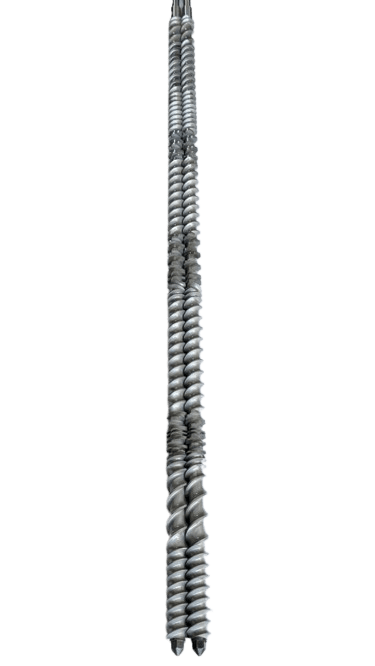
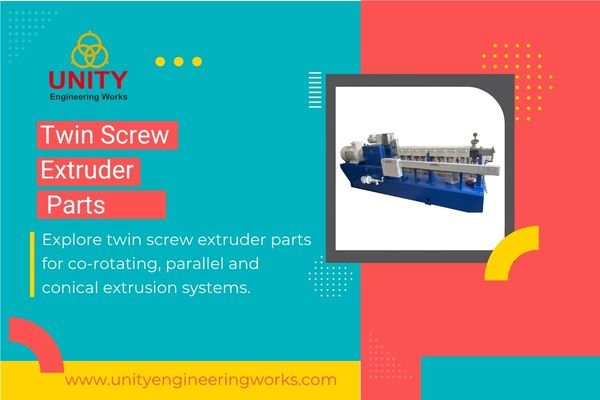
A twin screw extruder is built from several precision-engineered parts that work together during material processing.
While the complete machine is responsible for extrusion, the screw elements, shafts, kneading blocks, mixing elements, and barrel segments determine how material moves and is processed inside the machine.
Different applications require different combinations of these parts.
A configuration designed for conveying may not be suitable for intensive mixing. Similarly, a screw element arrangement used for one polymer may not provide the required processing conditions for another material.
Understanding individual twin screw extruder parts therefore helps manufacturers select, maintain, and configure extrusion equipment more effectively.
What Are Twin Screw Extruder Parts?
Twin screw extruder parts are the mechanical components used to build and support the screw and barrel processing system.
Important parts include:
- Screw elements
- Twin screw shafts
- Kneading blocks
- Mixing elements
- Conveying elements
- Reverse elements
- Barrel segments
The exact combination depends on:
- Material being processed
- Required output
- Mixing requirements
- Processing temperature
- Screw speed
- Machine configuration
This modular approach allows manufacturers to develop different screw and barrel arrangements for specific applications.
1. Extruder Screw Elements
Extruder screw elements are individual sections assembled onto the screw shaft.
Rather than using one continuous screw, modular twin screw systems use different elements for different processing functions.
Common screw elements include:
- Conveying elements
- High-pitch elements
- Low-pitch elements
- Reverse elements
- Mixing elements
- Kneading elements
Each element influences material movement and processing intensity.
Why Screw Elements Matter
The correct screw element arrangement helps control:
- Material conveying
- Residence time
- Mixing
- Melting
- Pressure generation
A properly designed configuration provides a controlled progression from feeding to final discharge.
2. Twin Screw Extruder Shafts
The shaft provides the foundation on which individual screw elements are assembled.
Twin screw extruder shafts transfer rotational force from the drive system to the screw elements.
A shaft must provide:
- Accurate element positioning
- Reliable torque transmission
- Proper alignment
- Mechanical stability
Shaft geometry and connection design are particularly important in modular extrusion systems because multiple screw elements must remain accurately positioned during operation.
3. Extruder Kneading Blocks
Extruder kneading blocks are designed to create intensive mixing and controlled material deformation.
They are commonly used when stronger distributive or dispersive mixing is required.
Depending on their geometry and arrangement, kneading blocks can influence:
- Shear intensity
- Mixing level
- Residence time
- Material homogenization
However, more intensive mixing is not automatically better.
The configuration needs to match the processing requirements of the material.
4. Extruder Mixing Elements
Extruder mixing elements help distribute materials uniformly throughout the melt.
They are particularly useful when processing formulations containing multiple ingredients.
Mixing elements can support:
- Additive distribution
- Filler dispersion
- Color distribution
- Melt homogenization
The positioning of mixing elements within the screw configuration is also important.
Placing them at the wrong location can alter residence time, pressure, and processing intensity.
5. Extruder Barrel Segments
The barrel provides the processing chamber around the screws.
In modular systems, the barrel is divided into individual extruder barrel segments.
Each section can be designed for a particular processing zone.
For example:
- Feeding zone
- Melting zone
- Mixing zone
- Degassing zone
- Pressure-building zone
Benefits of Segmented Barrels
A modular barrel arrangement allows manufacturers to:
- Replace individual worn sections
- Inspect specific processing zones
- Modify barrel configuration
- Reduce maintenance requirements
This makes segmented barrel systems particularly useful for demanding extrusion applications.
6. Conveying Elements
Conveying elements move material through the barrel.
Their geometry affects:
- Material transport
- Throughput
- Residence time
- Filling level
Different pitches can produce different conveying characteristics.
High-Pitch Elements
Generally provide faster material movement.
Low-Pitch Elements
Can provide greater material residence and filling compared with higher-pitch conveying sections.
The correct combination depends on the desired processing conditions.
7. Reverse Screw Elements
Reverse elements are used to restrict or redirect material flow.
They can increase:
- Local filling
- Pressure
- Residence time
- Mixing intensity
However, their use requires careful configuration because excessive restriction can increase mechanical and thermal stress.
8. Co-Rotating Twin Screw Elements
Co-rotating twin screw elements are designed for machines where both screws rotate in the same direction.
This configuration is widely associated with:
- Compounding
- Mixing
- Homogenization
- Material modification
Modular screw elements allow the processing profile to be adjusted according to the application.
9. Parallel Twin Screw Parts
Parallel twin screw parts are used in extrusion systems where the two screw channels maintain a parallel geometry along the processing section.
Depending on the machine design, these systems can incorporate:
- Screw elements
- Shafts
- Barrel sections
- Kneading blocks
- Mixing elements
Component selection should always match the specific machine geometry and processing requirement.
10. Conical Twin Screw Elements
Conical twin screw elements are used in conical twin screw extrusion systems where the screw and barrel geometry changes along the processing direction.
These systems have different mechanical and processing characteristics from parallel configurations.
Therefore, screw elements should be selected according to:
Screw geometry
Barrel dimensions
Material characteristics
Required output
Processing conditions
Components from one machine configuration should not automatically be treated as interchangeable with another.
How Screw Elements Work Together
A twin screw configuration is not simply a collection of individual parts.
Each element influences the next processing zone.
A typical material path may include:
Feeding → Conveying → Compression → Melting → Mixing → Homogenization → Pressure Building → Discharge
Different screw elements can be positioned along this path to achieve the desired processing conditions.
This is why screw configuration should be considered as a complete system rather than selecting individual elements independently.
Why Screw Element Arrangement Matters
Two extruders can have similar dimensions but produce different results because their screw configurations are different.
The arrangement affects:
- Material residence time
- Shear conditions
- Mixing intensity
- Pressure development
- Melting behavior
- Output stability
For this reason, screw configuration should be developed around the material and application rather than using the same arrangement for every extrusion process.
When Should Twin Screw Extruder Parts Be Replaced?
Replacement depends on operating conditions and component wear.
Manufacturers should inspect components when experiencing:
- Reduced output
- Pressure fluctuations
- Poor mixing
- Increased motor load
- Unstable extrusion
- Visible component wear
- Changes in product quality
Early inspection can help identify individual components requiring attention before they affect the entire extrusion system.
Benefits of Modular Twin Screw Extruder Parts
Modular components provide several practical advantages.
Easier Maintenance
Individual components can be inspected and replaced without replacing the entire screw assembly.
Configuration Flexibility
Different screw elements can be combined according to application requirements.
Reduced Replacement Cost
Only affected components may need replacement when appropriate.
Application-Specific Design
The screw can be configured for different materials and processing requirements.
Easier Process Modification
Existing configurations can potentially be modified by changing selected elements.
How to Select the Right Twin Screw Extruder Parts
Before selecting components, manufacturers should evaluate:
Material
Consider:
- Polymer type
- Filler content
- Additives
- Processing sensitivity
Output
The required production rate influences conveying and pressure requirements.
Mixing Requirements
Determine whether the process needs:
- Distributive mixing
- Dispersive mixing
- Gentle homogenization
- Intensive mixing
Machine Geometry
Confirm:
- Screw diameter
- Screw center distance
- Shaft dimensions
- Barrel configuration
- Screw rotation arrangement
Operating Conditions
Consider:
- Screw speed
- Temperature
- Pressure
- Residence time
These factors help determine the appropriate combination of screw elements and barrel sections.
Custom Extruder Screw Manufacturing
Standard screw elements may not always meet a specific processing requirement.
A custom extruder screw manufacturer can develop screw configurations based on:
- Material formulation
- Machine dimensions
- Production requirements
- Mixing requirements
- Existing screw configuration
- Wear conditions
Custom manufacturing can involve selecting and arranging different screw elements, kneading blocks, and mixing sections according to the application.
For manufacturers experiencing recurring extrusion problems, reviewing the screw configuration can be an important part of process optimization.
Twin Screw Extruder Parts Maintenance Checklist
Regular inspection can help identify problems before they affect production.
Screw Elements
✔ Check flight surfaces
✔ Inspect for wear
✔ Check element alignment
✔ Look for surface damage
Shafts
✔ Inspect connection areas
✔ Check for wear
✔ Verify proper alignment
✔ Inspect torque-transmitting surfaces
Kneading Blocks
✔ Check edges for wear
✔ Inspect mixing surfaces
✔ Monitor changes in processing behavior
Barrel Segments
✔ Inspect internal surfaces
✔ Check for excessive clearance
✔ Examine heating and cooling zones
✔ Replace worn sections when required
Conclusion
Twin screw extruder performance depends on much more than the main machine assembly.
Extruder screw elements, twin screw extruder shafts, kneading blocks, mixing elements, and barrel segments each contribute to how material is conveyed, mixed, melted, and discharged.
The right combination of components can help manufacturers achieve more controlled processing and consistent production.
For specialized applications, custom screw and barrel configurations can provide greater flexibility than relying on a standard arrangement.
Understanding the function of each component is therefore an important step toward selecting the right extrusion solution.
Looking for Custom Twin Screw Extruder Parts?
Unity Engineering Works specializes in the design and manufacturing of precision extrusion components, including:
Screw Elements
Extruder Screw Elements
Kneading Elements
Mixing Elements
Twin Screw Shafts
Barrel Segments
Conveying Elements
Custom Screw Configurations
For manufacturers looking for twin screw extruder parts or customized screw and barrel components, contact Unity Engineering Works to discuss the required machine configuration and application.