
Introduction
Investing in a twin screw extruder is a major decision for PVC and UPVC pipe manufacturers. While machine specifications and purchase prices are important, the actual value of an extrusion machine depends on its productivity, operating costs, product quality, maintenance requirements and long-term profitability.
Calculating twin screw extruder ROI helps manufacturers determine whether a new machine can deliver sufficient financial returns. It also allows businesses to compare equipment options and make informed investment decisions.
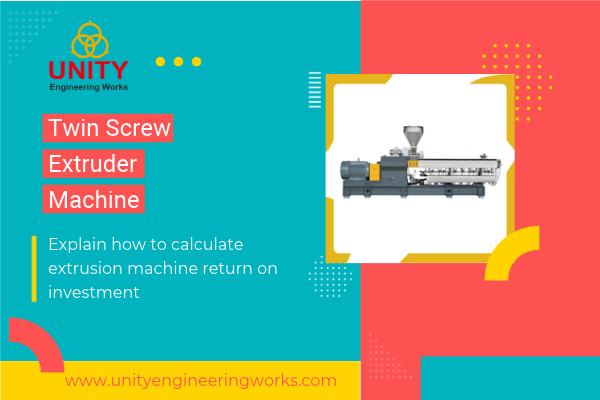
In this guide, we explain how to calculate extrusion machine return on investment, estimate the payback period and identify the factors that influence profitability.
What Is Twin Screw Extruder ROI?
Return on investment (ROI) measures the financial benefit generated by an extrusion machine compared with its initial investment.
For PVC pipe manufacturers, ROI depends on factors such as production capacity, operating hours, energy consumption, material waste, maintenance expenses and the contribution margin generated from finished products.
A machine with a lower purchase price does not necessarily deliver better ROI. Equipment that offers stable production, consistent product quality and lower operating costs may generate greater value over its working life.
Twin Screw Extruder ROI Formula
The basic ROI formula is:
ROI (%) = (Net Return ÷ Total Investment) × 100
For an equipment investment, net return should be calculated over a defined period after accounting for relevant operating costs and the initial investment.
Manufacturers can also calculate the simple payback period:
Payback Period = Initial Investment ÷ Annual Net Cash Benefit
These calculations help estimate how long it may take for the financial benefits of a new extrusion machine to recover the original investment.
1. Calculate the Total Investment Cost
The first step is to identify the complete investment required to install and operate the new extrusion equipment.
Important expenses may include:
- Twin screw extruder machine purchase cost
- Die head and tooling expenses
- Vacuum calibration and cooling equipment
- Haul-off and cutting machinery
- Electrical installation and utility connections
- Transportation, commissioning and operator training
- Additional working capital requirements
For an accurate comparison, manufacturers should include all relevant costs rather than considering only the machine quotation.
2. Estimate Annual Production Capacity
Production capacity directly affects the revenue-generating potential of an extrusion line.
Theoretical annual production can be estimated using:
Annual Production (kg) = Output (kg/hour) × Operating Hours per Day × Operating Days per Year
For example, consider a hypothetical PVC pipe extrusion line with:
| Parameter | Example |
|---|---|
| Average production output | 200 kg/hour |
| Operating hours | 16 hours/day |
| Operating days | 300 days/year |
| Theoretical annual output | 960,000 kg |
This figure represents theoretical output under the stated assumptions. Actual saleable production may be lower because of downtime, changeovers, scrap and operating limitations.
Manufacturers should therefore calculate realistic production using historical operating data or verified machine trials.
3. Calculate Operating Costs
Operating costs determine how much revenue remains after production expenses.
Electricity Consumption
Electricity is an important expense in extrusion operations. Power consumption can vary according to screw configuration, material formulation, heating requirements, machine loading and auxiliary equipment.
Calculate annual electricity costs using:
Annual Electricity Cost = Average Power Demand (kW) × Annual Operating Hours × Electricity Tariff
Use measured or realistically estimated total line power demand rather than motor nameplate power alone.
Raw Material Consumption
PVC resin, additives, stabilizers, fillers and other formulation components represent a significant share of production costs.
Material waste, startup scrap and rejected pipes can increase the effective cost per kilogram of saleable production.
Labour and Maintenance
Include operator wages, routine maintenance, replacement components, lubrication, inspections and expected repair expenses.
For additional technical context, manufacturers can read our guide on key components of a twin extruder.
4. Measure Savings from Better Production Efficiency
A new twin screw extruder may improve profitability through more consistent production and reduced operational losses.
Potential savings include:
Reduced Material Waste: Stable processing conditions may reduce rejected products and unnecessary material consumption.
Improved Production Output: Higher usable throughput can increase the volume of saleable products when sufficient market demand exists.
Lower Maintenance Downtime: Appropriate machine design and maintenance planning can help minimize unplanned production interruptions.
Better Product Consistency: Stable extrusion conditions support consistent dimensions and quality, potentially reducing rework and customer complaints.
The financial value of each improvement should be based on measured production data, not assumed percentage savings.
Manufacturers can also explore the advantages of segmented screw and barrel systems to understand their potential maintenance benefits.
5. Calculate the Extruder Machine Payback Period
he payback period indicates how long it takes to recover the investment through annual net cash benefits.
Example ROI Calculation
Consider a hypothetical manufacturer investing in a new extrusion line.
| Financial parameter | Illustrative value |
|---|---|
| Total equipment and installation investment | ₹50,00,000 |
| Annual additional contribution from saleable production | ₹18,00,000 |
| Annual operating cost savings | ₹7,00,000 |
| Additional annual operating and maintenance costs | ₹5,00,000 |
| Annual net cash benefit | ₹20,00,000 |
Simple Payback Period = ₹50,00,000 ÷ ₹20,00,000 = 2.5 years
In this example, the manufacturer could recover the initial investment in approximately 2.5 years, assuming the estimated annual cash benefits are achieved.
For a five-year simplified calculation:
Five-Year Net Return = (₹20,00,000 × 5) − ₹50,00,000 = ₹50,00,000
Five-Year Simple ROI = (₹50,00,000 ÷ ₹50,00,000) × 100 = 100%
These figures are illustrative only. They exclude financing costs, taxes, depreciation effects, inflation, changes in working capital and the time value of money. Actual investment decisions should account for these factors.
6. Factors That Affect Twin Screw Extruder Profitability
Several technical and commercial factors influence long-term profitability.
Screw and Barrel Design
The screw and barrel configuration affects material conveying, mixing, pressure generation and processing stability.
Manufacturers should select configurations that match their material formulation and production requirements.
Learn more in our twin extruder screw design guide.
Production Demand
Higher machine output creates financial value only when the manufacturer can sell the additional production.
Before investing in a larger extrusion line, businesses should evaluate customer demand, available orders and market growth opportunities.
Machine Reliability
Unplanned downtime can reduce production output and increase operating expenses.
A reliable maintenance program and access to suitable replacement components are important considerations when evaluating equipment.
Product Quality
Consistent pipe dimensions, surface finish and material processing can reduce scrap and improve the percentage of saleable production.
However, actual improvements depend on the complete extrusion line, raw material quality, tooling and operating practices.
7. Compare Initial Price with Total Cost of Ownership
The purchase price represents only one part of the overall cost of extrusion machinery.
Total cost of ownership includes:
- Initial machine and installation expenses
- Energy and utility consumption
- Labour and operating expenses
- Spare parts and maintenance
- Production losses during downtime
- Tooling and component replacement
- Expected resale or residual value
Comparing these costs over the same operating period provides a more meaningful evaluation than comparing quotations alone.
A manufacturer should also assess warranty terms, technical support, component availability and suitability for the intended PVC or UPVC application.
8. How to Improve ROI After Installing an Extruder
Manufacturers can improve financial performance by monitoring both production and operating costs.
Monitor Actual Output
Track saleable kilograms produced per operating hour rather than relying exclusively on rated machine capacity.
Reduce Unplanned Downtime
Maintain regular inspection schedules for screws, barrels, gearboxes, heating systems and other critical equipment.
Control Material Waste
Monitor startup scrap, rejected products and raw material losses to identify opportunities for improvement.
Optimize Operating Parameters
Maintain suitable processing temperatures, feed rates and screw speeds for the material and equipment.
Review Production Cost per Kilogram
Calculate the total cost of producing one kilogram of acceptable finished product.
This metric helps manufacturers compare production efficiency across shifts, products and equipment.
9. Questions to Ask Before Investing in a Twin Screw Extruder
Before purchasing an extrusion machine, manufacturers should evaluate:
- What is the expected saleable production output?
- What is the complete installation and commissioning cost?
- How much electricity will the entire production line consume?
- What are the expected maintenance requirements?
- What level of material waste should be included in financial projections?
- Can existing customer demand support the planned production capacity?
- How long is the estimated investment payback period?
- What technical support and replacement components are available?
These questions help businesses build realistic financial projections and reduce investment uncertainty.
Conclusion
Calculating twin screw extruder ROI allows PVC and UPVC pipe manufacturers to evaluate equipment investments using measurable financial and production data.
Rather than focusing only on machine price, manufacturers should consider total investment, saleable production capacity, energy consumption, material waste, maintenance costs and expected cash benefits.
A well-planned extrusion machinery investment can support sustainable production growth when equipment capability aligns with business demand and operating requirements.
Looking for a Twin Screw Extruder Manufacturer?
Unity Engineering Works supports manufacturers exploring extrusion machinery solutions for their production requirements.
Whether you are planning a new PVC or UPVC extrusion project or evaluating equipment for an existing manufacturing facility, selecting the right machine configuration is an important part of your investment decision.
Contact Unity Engineering Works to discuss your material, production capacity and extrusion machinery requirements.