
Introduction
A twin extruder is the heart of a PVC pipe manufacturing line. While many operators focus on production output and machine settings, the real performance of an extrusion system depends on how its individual components work together.
Each component performs a specific function during the extrusion process. From feeding raw materials into the machine to shaping the final product, every part contributes to efficiency, quality, and reliability.
When one component fails to perform properly, the entire extrusion process can suffer, resulting in lower output, poor product quality, and increased maintenance costs. Understanding the key components of a twin extruder helps manufacturers optimize operations and make informed maintenance decisions.
What Is a Twin Extruder?
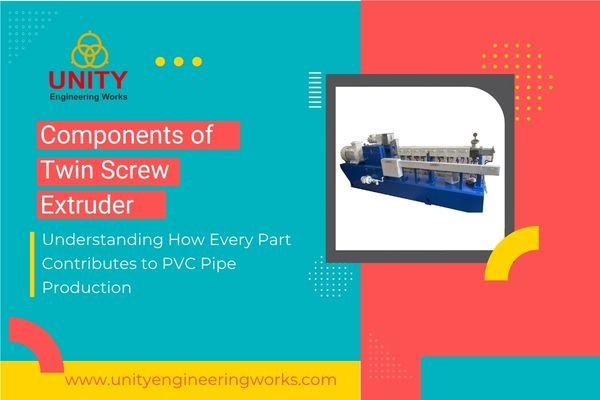
A twin extruder is an extrusion machine that uses two intermeshing screws rotating inside a segment barrel to process material.
In PVC pipe manufacturing, twin extruders are widely preferred because they provide:
- Excellent mixing performance
- Stable melt pressure
- Uniform fusion
- Consistent output
- Better process control
The machine combines mechanical, thermal, and electrical systems to transform PVC dry blend into a homogeneous melt ready for shaping.
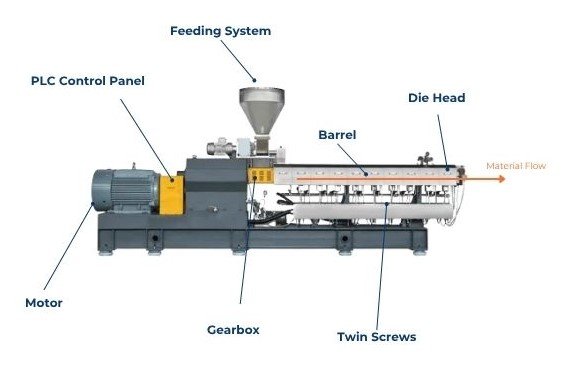
1. Feeding System
The extrusion process begins with the feeding system.
Its primary role is to supply a consistent quantity of PVC dry blend into the extruder.
Functions
- Delivers raw material to the screws
- Maintains production consistency
- Supports stable pressure generation
Common Problems
- Hopper bridging
- Inconsistent feeding
- Material segregation
- Moisture-related flow issues
Even a small variation in feeding can affect the entire production process.
Proper feeder calibration is essential for maintaining stable output.
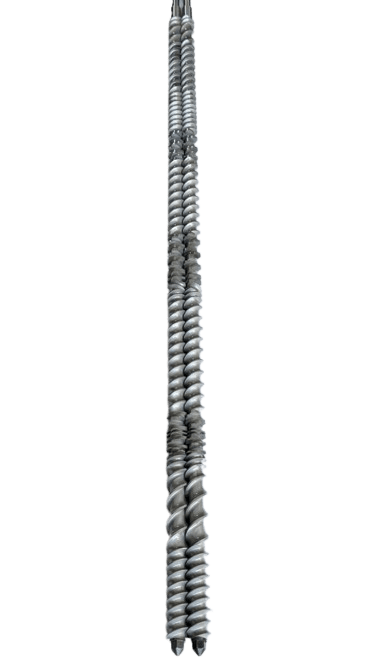
2. Twin Extruder Screws
The screws are among the most critical components of the machine.
They perform multiple functions simultaneously:
- Material conveying
- Compression
- Mixing
- Plasticizing
- Pressure generation
As the screws rotate, they move material forward while generating the mechanical energy required for processing.
Why Screw Design Matters
The screw configuration directly affects:
- Output capacity
- Fusion quality
- Material homogeneity
- Energy efficiency
An optimized screw design helps achieve stable processing and consistent pipe quality.
3. Barrel Assembly
The barrel houses the rotating screws and provides the environment necessary for material processing.
The barrel is divided into multiple heating zones that allow precise temperature control throughout the extrusion process.
Functions
- Supports screw operation
- Provides thermal control
- Maintains processing stability
- Guides material flow
The interaction between the screws and barrel determines how effectively material is mixed and fused.
4. Heating and Cooling System
Temperature control is one of the most important aspects of PVC processing.
The heating and cooling system ensures that material remains within the optimal processing window.
Functions
- Heats material gradually
- Prevents overheating
- Maintains fusion consistency
- Supports stable melt flow
Improper temperature control can cause:
- Material degradation
- Poor fusion
- Surface defects
- Product rejection
Modern twin extruders use multiple temperature zones for precise control.
5. Gearbox
The gearbox transfers power from the motor to the screws.
It converts motor speed into the torque required for extrusion.
Importance of the Gearbox
The gearbox directly affects:
- Production stability
- Torque generation
- Machine reliability
- Long-term performance
Because PVC processing requires high torque, the gearbox must be designed to handle heavy loads continuously.
Signs of Gearbox Problems
- Unusual noise
- Vibration
- Oil leakage
- Temperature rise
Regular inspection helps prevent unexpected breakdowns.
6. Drive Motor
The drive motor powers the entire extrusion process.
It provides the energy required to rotate the screws and move material through the barrel.
Key Considerations
- Motor efficiency
- Load stability
- Energy consumption
- Speed control
Modern systems often use variable frequency drives (VFDs) to optimize motor performance and energy efficiency.
7. Die Head
Once material has been melted and homogenized, it enters the die head.
The die shapes the molten material into the desired product profile.
For PVC pipe production, the die determines:
- Pipe diameter
- Wall thickness
- Product geometry
A properly designed die helps ensure:
- Uniform flow
- Stable dimensions
- Consistent product quality
After leaving the die, the pipe enters the vacuum calibration section.
This system maintains:
- Pipe diameter
- Roundness
- Dimensional accuracy
Vacuum calibration plays a crucial role in achieving product consistency.
Without proper calibration, even a perfectly functioning extruder may produce defective pipes.
9. Cooling System
The cooling system solidifies the pipe while maintaining dimensional stability.
Functions
- Controls shrinkage
- Prevents deformation
- Improves surface finish
- Supports dimensional accuracy
Uniform cooling is essential for producing high-quality PVC pipes.
10. PLC Control System
Modern twin extruders rely on advanced PLC and HMI systems for process management.
The control system monitors:
- Temperature
- Pressure
- Motor load
- Screw speed
- Production parameters
Benefits
- Improved automation
- Better process consistency
- Reduced operator error
- Faster troubleshooting
Digital controls help manufacturers achieve higher productivity and better quality control.
How All Components Work Together
A twin extruder functions as an integrated system.
The process follows a continuous sequence:
- The feeding system introduces material.
- The screws convey and mix the material.
- The barrel provides thermal control.
- The gearbox and motor generate torque.
- The die shapes the molten material.
- The calibration system stabilizes dimensions.
- The cooling system solidifies the product.
- The PLC system monitors and controls the entire operation.
If any component performs poorly, the overall efficiency of the extrusion line decreases.
This is why successful PVC pipe production depends on the coordinated performance of every system.
Benefits of Understanding Twin Extruder Components
Manufacturers who understand machine components can:
- Improve production efficiency
- Reduce downtime
- Troubleshoot faster
- Optimize maintenance schedules
- Increase equipment lifespan
A deeper understanding of machine operation often leads to significant improvements in both productivity and profitability.
Conclusion
A twin extruder is much more than a machine with two screws. It is a combination of precisely engineered components working together to achieve stable processing, consistent output, and high-quality PVC pipe production.
From the feeding system and screws to the gearbox, barrel, die, and control system, every component plays a critical role in extrusion performance.
By understanding how these components interact, manufacturers can improve operational efficiency, reduce maintenance costs, and maximize the return on their extrusion investment.
Need Expert Guidance on Twin Extruder Systems?
Unity Engineering Works specializes in high-performance twin extruder solutions for PVC and UPVC pipe manufacturing.
Our team provides:
- Twin extruder manufacturing
- Process optimization support
- Technical consultation
- Extrusion troubleshooting assistance
- Production efficiency improvements