
Introduction
Every twin extruder relies on shear to process material efficiently.
Without shear, PVC resin cannot be properly mixed, plasticized, or fused into a homogeneous melt. However, excessive shear can be just as problematic as insufficient shear.
In PVC pipe manufacturing, uncontrolled shear often leads to:
- Material degradation
- Discoloration
- Burn marks
- Reduced mechanical strength
- Poor fusion quality
- Increased rejection rates
Understanding the science behind shear helps manufacturers optimize production while protecting material quality.
What Is Shear in a Twin Extruder?
Shear refers to the mechanical force generated when material layers move against each other under pressure and rotation.
Inside a twin extruder, shear is created by:
- Screw rotation
- Material compression
- Intermeshing screw action
- Barrel friction
- Melt flow resistance
This energy helps convert PVC dry blend into a uniform molten material suitable for extrusion.
Proper shear is essential because it:
- Promotes fusion
- Improves mixing
- Distributes additives uniformly
- Creates a stable melt
Without adequate shear, material cannot be processed correctly.
Why Shear Is Critical in PVC Processing
PVC is a heat-sensitive material.
Unlike many other polymers, PVC requires careful control of both temperature and mechanical energy.
The twin extruder must generate enough shear to:
- Achieve proper fusion
- Homogenize additives
- Stabilize melt flow
At the same time, excessive shear must be avoided to prevent degradation.
This balance is one of the most important aspects of successful PVC extrusion.
How Excessive Shear Causes Material Degradation
When shear levels become too high, excessive friction generates additional heat inside the barrel.
As temperature rises beyond the material’s processing window, degradation begins.
Common consequences include:
Thermal Breakdown
PVC molecules start to deteriorate under excessive heat and mechanical stress.
Discoloration
Manufacturers may observe:
- Yellowing
- Brown streaks
- Burn marks
Reduced Mechanical Strength
Degraded material often produces weaker pipes with reduced impact resistance.
Poor Surface Finish
Excessive shear can create:
- Rough surfaces
- Melt instability
- Visible defects
Common Causes of Excessive Shear in Twin Extruders
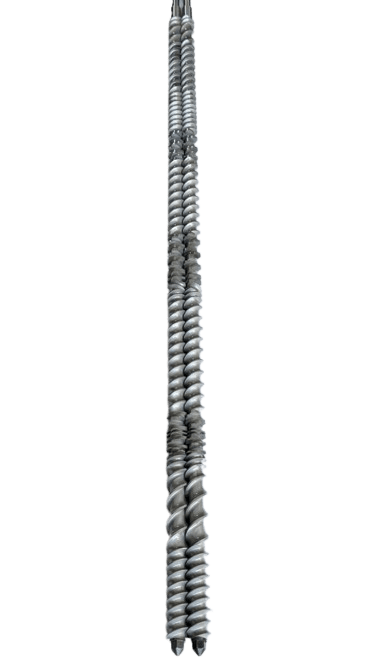
1) Incorrect Screw Configuration
The screw design directly influences shear generation.
Aggressive screw elements may create excessive mechanical energy.
Potential issues include:
- Over-compression
- Excessive mixing intensity
- High friction zones
Related: Twin Extruder Screw Design Explained
2) Excessive Screw Speed
Higher RPM increases:
- Material movement
- Friction
- Shear forces
While increased speed may improve output, it can also increase degradation risk if not properly controlled.
3) Improper Barrel Temperature Settings
Temperature and shear work together.
If barrel temperatures are too high while shear remains elevated, material degradation accelerates.
4) Restricted Material Flow
Flow restrictions force material to remain under stress for longer periods.
Common causes include:
- Die restrictions
- Partial blockages
- Improper calibration
The result is additional shear and higher melt temperatures.
5) Worn Processing Components
Damaged screws or barrels can disrupt normal material flow patterns.
This often creates localized shear hotspots that accelerate degradation.
Warning Signs of Material Degradation
Operators should monitor for:
Color Changes
The earliest indicator of degradation.
Watch for:
- Yellowing
- Brown discoloration
- Black specks
Burnt Odor
Overheated PVC often produces a distinctive odor during processing.
Surface Defects
Common defects include:
- Rough finish
- Streaking
- Melt fracture
- Pressure Instability
Degraded material often creates inconsistent flow behavior.
Reduced Product Strength
Finished pipes may fail quality tests despite appearing acceptable visually.
How to Control Shear Effectively
Optimize Screw Design
Choose screw configurations that balance:
- Mixing
- Fusion
- Throughput
without generating excessive mechanical stress.
Maintain Stable Feeding
Inconsistent feeding often causes fluctuating shear conditions.
Maintain:
- Uniform material flow
- Proper feeder calibration
- Consistent dry blend quality
Related: PVC Dry Blend Feeding Problems
Control Screw Speed Carefully
Higher RPM does not always mean better performance.
Optimize speed based on:
- Material formulation
- Production requirements
- Equipment design
Monitor Melt Temperature
Regular temperature monitoring helps identify excessive shear before product quality suffers.
Track:
- Barrel temperatures
- Melt temperatures
- Process trends
The Relationship Between Shear and Fusion
A common misconception is that more shear automatically produces better fusion.
In reality:
Too Little Shear
Results in:
- Poor melting
- Incomplete fusion
- Weak products
- Too Much Shear
Results in:
- Degradation
- Burn marks
- Material breakdown
- Optimal Shear
Produces:
- Stable fusion
- Excellent mixing
- Consistent pipe quality
- Efficient production
The goal is balance, not maximum shear.
Best Practices for Preventing Material Degradation
Maintain stable process conditions
- Use proper screw configurations
- Monitor melt temperatures regularly
- Avoid excessive screw speeds
- Keep equipment properly maintained
- Train operators to recognize early warning signs
Conclusion
Shear is one of the most critical variables in PVC extrusion.
When properly controlled, it helps achieve:
- Uniform mixing
- Stable fusion
- Consistent product quality
- Higher production efficiency
However, excessive shear can quickly lead to degradation, product defects, and unnecessary production losses.
By understanding how shear works and implementing proper process control strategies, manufacturers can improve both product performance and long-term extrusion reliability.
Need Expert Support for Twin Extruder Optimization?
Unity Engineering Works provides:
- Twin extruder manufacturing solutions
- PVC extrusion process optimization
- Screw configuration guidance
- Extrusion troubleshooting support
- Technical consultation for PVC pipe manufacturers