
Introduction
In the world of high-precision extrusion, the screw is the heart of the machine. However, many operators treat the screw as a single, static component. At Unity Engineering, we utilize a modular, segmented design because we know that one size—or one configuration—does not fit all.
Mastering your output quality often comes down to one question: Are your screw segments optimized for your specific material?
Anatomy of an Extruder Screw
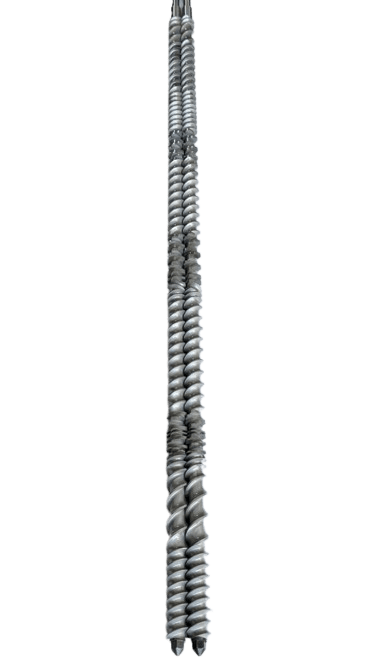
An extruder screw is a collection of individual elements, each with a distinct purpose. By arranging these elements differently, you can fundamentally change how your material is processed
- Conveying Elements : These are designed to transport the material forward through the barrel. They are the workhorses of the screw, ensuring a steady, consistent feed of raw material.
- Kneading Blocks : These are the key to high-quality mixing. By creating chaotic flow and high shear, they ensure that additives, fillers, and resins are perfectly dispersed throughout the melt.
- Reverse-Flow Elements : Sometimes, you need to hold the material in a specific zone for a longer period to ensure full plasticization. Reverse elements provide back-pressure, forcing the material to work harder before moving forward.
The Impact on Mixing
If you are struggling with “streaking” or inconsistent dispersion in your product, your current screw configuration may be lacking the right shear intensity. Mixing is generally divided into two types:
- Distributive Mixing: Spreading ingredients evenly throughout the base resin without necessarily breaking down the particles.
- Dispersive Mixing: Using high shear forces to break down agglomerates or pigments into smaller, uniform particles.
By strategically placing kneading blocks and shear elements in your screw assembly, you can fine-tune the balance between these two types of mixing, ensuring a superior, homogeneous output every time.
A Practical Look at Applications
Different materials demand different configurations. For example:
- Highly Filled Materials: If you are adding a high percentage of calcium carbonate or other fillers to PVC, you need a high-shear configuration to ensure those fillers don’t clump.
- Heat-Sensitive Polymers: For materials that degrade easily, you want to minimize localized hot spots. This requires a “gentler” screw design with fewer aggressive kneading blocks, focusing instead on steady, low-heat conveying and distributive mixing.
Your Partner in Customization
At Unity Engineering, we understand that your production needs evolve. That is why our extruders are built with a highly versatile, segmented screw design. Whether you are switching from standard PVC pipe production to a more complex, filled compound, our team can help you reconfigure your screw segments to achieve optimal mixing and throughput.