

Introduction
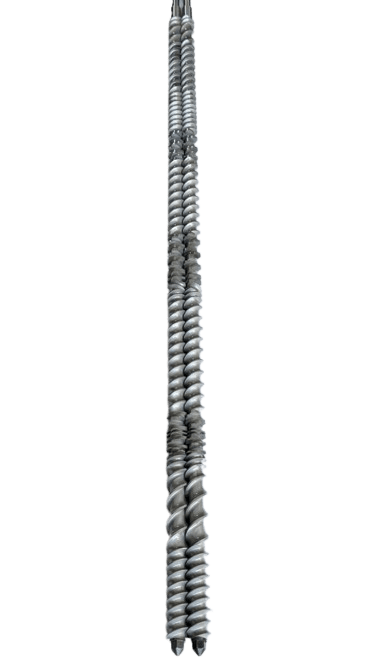
Screw elements technology involves modular, specialized components (conveying, kneading, mixing) assembled on shafts in twin-screw extruders to precisely control polymer processing, including melting, mixing, and degassing. Key advancements focus on material science (metallurgy, coatings), optimizing geometry for improved efficiency, reducing shear, increasing throughput, and ensuring self-cleaning.
Key Screw Element Types
- Conveying Elements: Transport materials forward. They can have different pitches (large for capacity, small for pressure) and are used for feeding, melting, and degassing.
- Kneading Elements: Staggered blocks used for dispersive and distributive mixing. Narrow lobes provide high distributive mixing, while wider lobes offer high dispersive mixing.
- Mixing Elements: Specialized elements like toothed mixers (ZME, TME), gear-type mixers, or blister rings designed for specific shear levels and homogenization.
- Specialty Elements: Includes reverse elements (for pressure increase/sealing) and barrier elements for improved mixing.
Technology & Performance Enhancements
- Modular Design: Enables customized screw configurations tailored to specific materials (e.g., plastics, food).
- Advanced Materials: Utilization of materials like high-strength steels, tungsten carbide coatings, and bi-metallic elements (Stellite, Colmonoy) to reduce wear.
- Fractional Geometry: Special patented profiles (e.g., fractional lobed) that allow constant, consistent free space between the screw and barrel.
- Improved Mixing and Shear: Technologies that offer high-efficiency mixing while reducing Specific Mechanical Energy Input (SMEI), crucial for sensitive materials.
Applications
Screw element technology is used in compounding engineering plastics, filler/color masterbatches, biodegradable plastics, and pharmaceutical granulation.