
PVC is rarely processed in its pure resin form. It must be compounded with:
- Heat stabilizers
- Lubricants
- Fillers (CaCO₃, etc.)
- Impact modifiers
- Pigments
The challenge?
Achieving uniform dispersion without degrading the material.
Poor compounding leads to:
 Surface defects
- Weak mechanical strength
- Color inconsistency
- Higher rejection rates
This is where twin screw extrusion technology becomes critical.
 Controlled Shear & Mixing
PVC is shear-sensitive. Excess shear causes degradation; insufficient shear leads to poor dispersion.
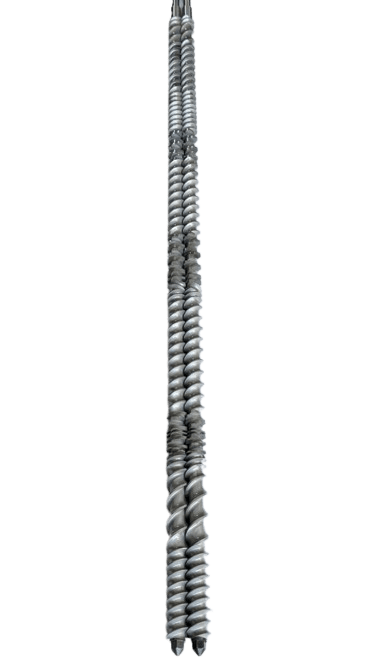
Twin screw extruders provide:
- Adjustable screw configurations
- Balanced shear zones
- Uniform material distribution
This ensures consistent compounding quality.
 Modular Screw Design for Custom Formulations
In compounding, flexibility is key.
Screw elements can include:
- Conveying elements
- Kneading blocks
- Reverse elements
- Mixing pins
This modular design allows engineers to optimize for:
- High filler loading
- High-impact formulations
- Rigid or flexible PVC
 Better Additive Dispersion
Uniform distribution of stabilizers and lubricants is essential to prevent:
- Thermal degradation
- Discoloration
- Brittleness
Intermeshing screws enhance:
- Dispersive mixing
- Distributive mixing
- Melt homogeneity
 Stable Temperature Profile
PVC begins degrading above certain temperature thresholds.
Twin screw extruders allow:
- Multi-zone barrel temperature control
- Gradual heat buildup
- Improved cooling integration
This reduces burning risk and improves product consistency.
 Efficient Degassing & Venting
During compounding, trapped air and volatiles can cause:
- Bubbles
- Surface imperfections
- Density variation
Twin screw systems provide:
- Venting zones
- Vacuum ports
- Controlled pressure release
Result: cleaner, more stable melt.