
Introduction: Why Extruder Selection Is a Critical Business Decision
Many manufacturers choose extrusion machines based on price or availability — and regret it later.
The wrong extruder can lead to:
- Poor mixing quality
- High rejection rates
- Excessive power consumption
- Limited material flexibility
- Frequent breakdowns
Selecting between a twin screw and single screw extruder should be based on:
- Material type
- Output requirement
- Product complexity
- Long-term operating cost
This guide explains the technical and commercial differences so you can make the right investment.
What Is a Single Screw Extruder?
A single screw extruder uses one rotating screw to convey, melt, and pressurize material.
Common Applications
- LDPE / HDPE pipes
- Simple profile extrusion
- Film & sheet extrusion
- Stable, uniform raw materials
Key Strengths
- Simple design
- Lower initial cost
- Easy operation
- Lower maintenance skill requirement
Limitations
- Poor mixing capability
- Limited formulation flexibility
- Not ideal for PVC dry blends
- Higher risk of surging
What Is a Twin Screw Extruder?
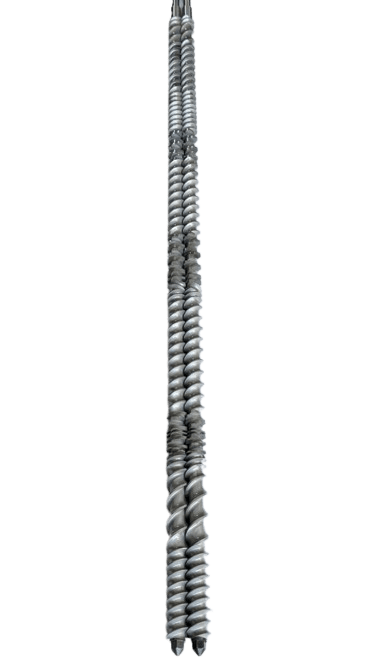
Twin screw extruders use two intermeshing screws, usually co-rotating, offering superior control over mixing and shear.
Common Applications
- PVC & UPVC pipes
- WPC profiles
- Masterbatch & compounding
- Filled and recycled materials
Key Strengths
- Excellent mixing & dispersion
- Stable output & pressure
- Handles complex formulations
- Better temperature control
- Higher automation compatibility
Limitations
- Higher initial investment
- Requires skilled setup
- More components
Twin-Screw vs Single-Screw: Side-by-Side Comparison
| Parameter | Single-Screw | Twin-Screw |
|---|---|---|
| Material Flexibility | Low | High |
| Mixing Efficiency | Low | Excellent |
| PVC Dry Blend Processing | ❌ Not Ideal | ✅ Best Choice |
| Output Stability | Medium | High |
| Energy Efficiency | Medium | Higher (optimized) |
| Automation Compatibility | Limited | Advanced PLC/IoT |
| Initial Cost | Lower | Higher |
| Long-Term ROI | Medium | High |
Why Twin-Screw Extruders Dominate PVC & UPVC Processing
PVC processing requires:
Precise temperature control
Uniform additive dispersion
Controlled shear
Stable melt pressure
Twin-screw extruders excel because:
 Each screw segment can be customized Mixing elements ensure uniform melt Lower degradation risk Better venting & degassing
That’s why most modern PVC & UPVC plants globally use twin screw extruders.
Cost vs ROI: What Manufacturers Often Miss
While single-screw extruders are cheaper upfront, twin-screw machines deliver:
- Higher throughput
- Lower scrap rate
- Reduced downtime
- Better product consistency
- Longer screw & barrel life
Over 3–5 years, twin-screw extruders often cost less per kg of output.
How to Choose the Right Extruder for Your Plant
Ask these questions before investing:
- Are you processing PVC, UPVC, WPC, or filled compounds?
- Do you plan to change formulations in the future?
- Is output stability critical?
- Are automation & PLC controls required?
- Do you want lower long-term operating cost?
If YES to most → Twin-Screw Extruder
If NO and material is simple → Single-Screw Extruder
Conclusion
There is no “one-size-fits-all” extruder — but there is a right choice for your application.
For:
- PVC & UPVC pipes
- Compounding & recycling
- High output with consistent quality
👉 Twin-screw extruders are the industry standard.
For:
- Simple polymers
- Limited formulation changes
👉 Single-screw extruders still make sense.
Need Help Choosing the Right Extruder?
We help manufacturers with:
- Extruder selection & line design
- Twin-screw customization
- Output & energy optimization
- Retrofit & upgrade consultation